

Easy Sukiyaki Recipe – Japanese Beef Hot Pot
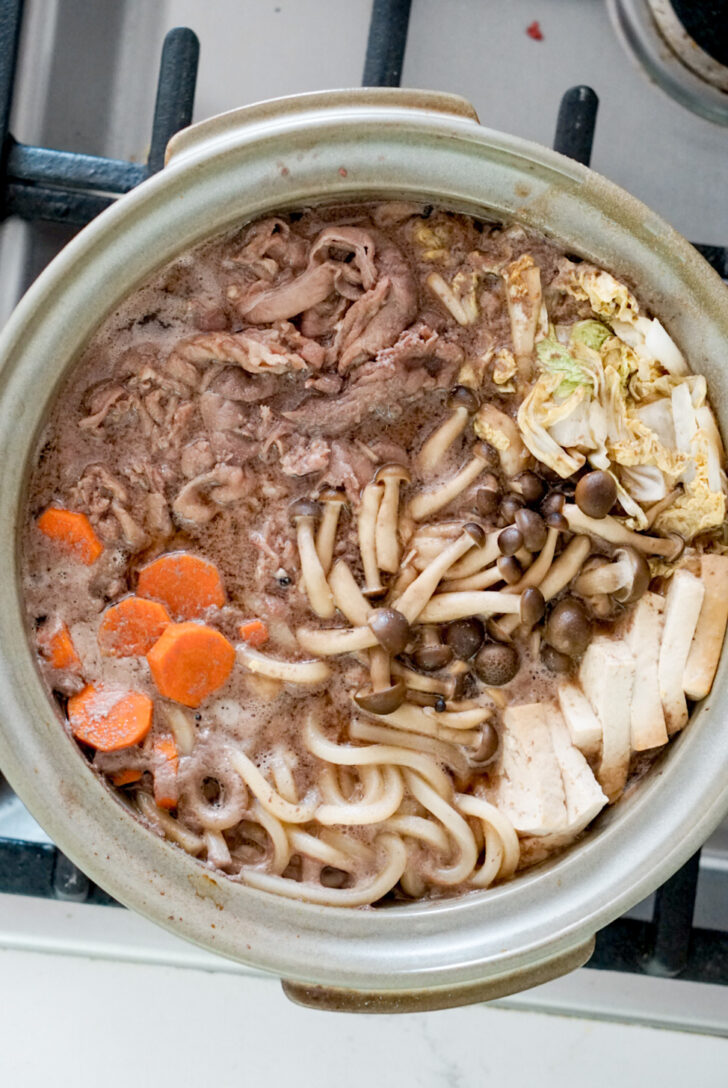
This easy sukiyaki recipe can be made in only one pot for simple Japanese home cooking. Sukiyaki is a type of Japanese hot pot that consists of thinly sliced beef and veggies simmered in a soy sauce based broth. Read through the post for more cultural background on sukiyaki or jump to recipe to get cooking.
What is Sukiyaki?
Sukiyaki is a Japanese hot pot dish… sometimes. I’ll explain more below. For those who aren’t familiar with it, a hot pot is an Asian meal that is boiled all in one pot, usually cooked and served right on the dining table, essentially a stew. There are variations of hot pots among different Asian countries, but some of my favorites are Japanese hot pots, which are referred to collectively as nabe.
Yes, you’ve read that right, hot pots, PLURAL.
Japan actually has several different styles of hot pot, including shabu shabu, oden, and my favorite, sukiyaki. Sukiyaki is a style of Japanese hot pot in which the ingredients (usually thinly sliced beef, veggies, and noodles) are cooked in a soy sauce flavored broth that tastes like a variation on teriyaki. That makes sense, as they use the same ingredients. Because the broth is so flavorful, you eat the food served over rice without adding anything after it’s cooked (there are exceptions to this, more on this below as well). This is different from shabu shabu, which consists of ingredients cooked in a clear broth and then dipped in flavorful sauces afterward.
Kanto vs. Kansai Sukiyaki
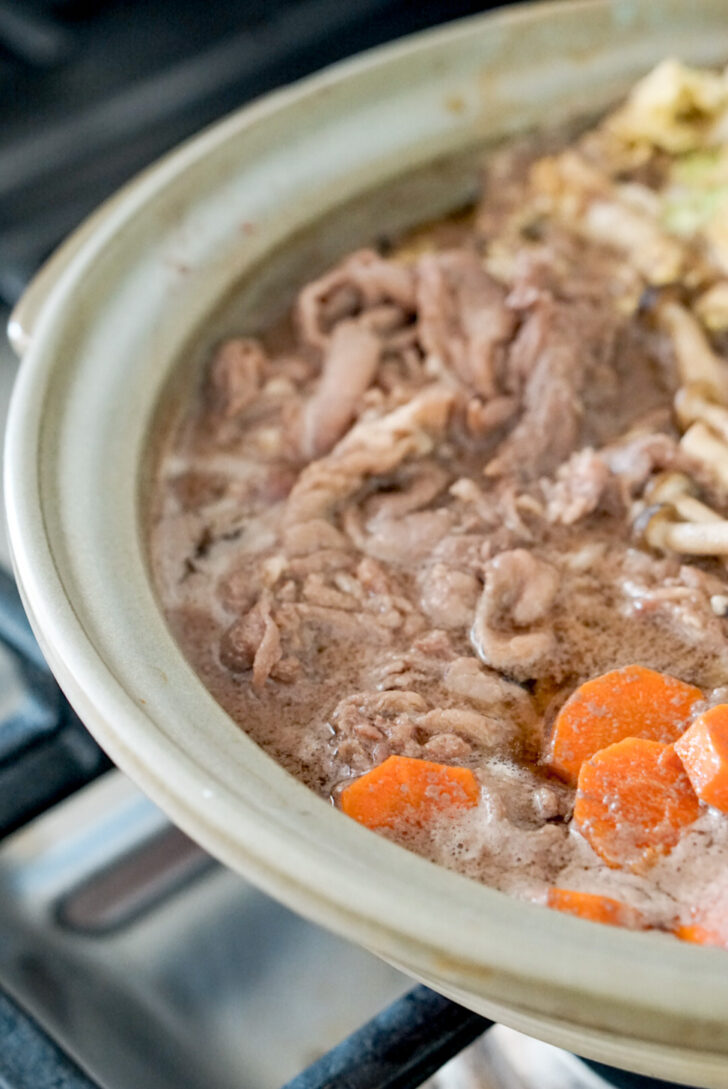
In Japan, there’s regional variations on sukiyaki. For example, the Kanto region, which includes Tokyo, has their own version which differs from the Kansai region, which includes Osaka and Kyoto. The recipe I have here is closer to Kanto style sukiyaki, which boils the food in a soy sauce seasoning broth called warishita.
Kansai style sukiyaki is actually more a grilled meat dish (yakiniku) rather than a hot pot (hence why I said sukiyaki is a hot pot only sometimes earlier). In this style, you grill the beef first, then add the seasoning ingredients directly to the pan to flavor the meat and veggies. It’s a similar cooking style to my teriyaki beef rolls. With Kansai style, you don’t add a lot of broth, so it’s not really simmering in liquid.
Sukiyaki in Japan vs. Sukiyaki in America
The funny thing about being a fourth generation Japanese American is that most of us don’t really know what region our food comes from (or if it’s even truly a Japanese dish vs. Japanese American). My recipe here uses a soy sauce seasoning that you mix separately and then add to the hot pot, along with a decent amount of broth, so it’s more like a Kanto style sukiyaki. However, I still don’t use all the same ingredients that you might commonly find in Japan.
For example, many Japanese recipes start off with beef tallow (fat) that you render in your pot. You can also grill large green onion slices in the fat. I do not typically cook with beef tallow, so I skip that step altogether.
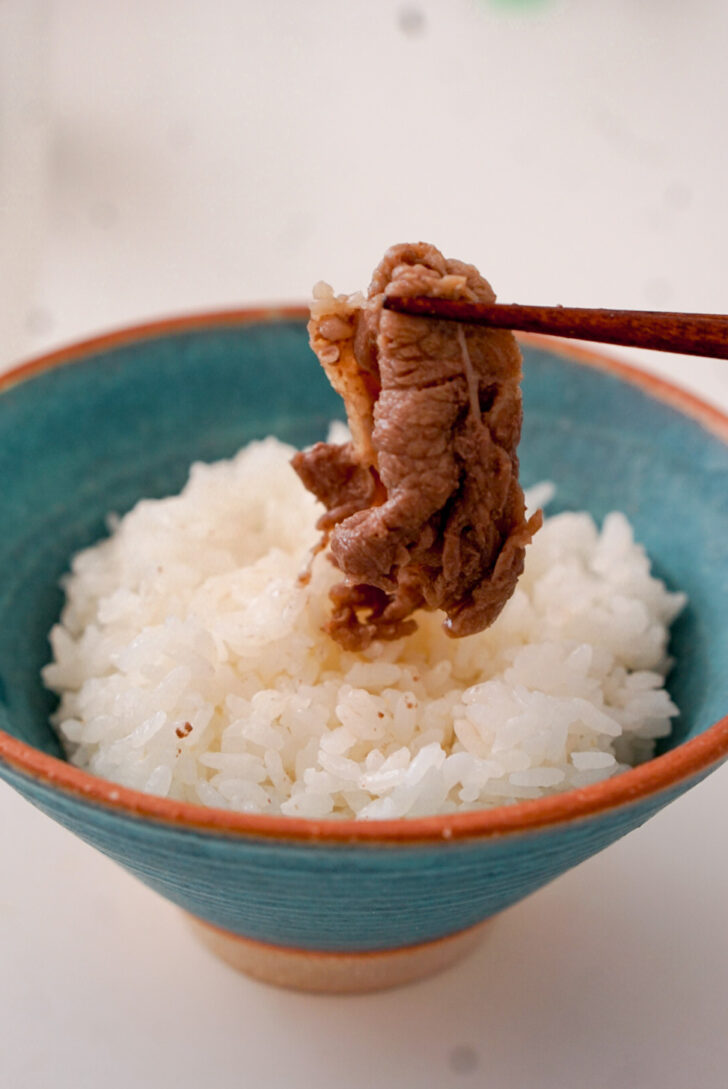
Sukiyaki in Japan also traditionally gets served with a side bowl of beaten raw egg. Japan’s way of sanitizing their eggs means a much lower chance of salmonella, so raw egg consumption is much more common there. After the ingredients are cooked, you dip them in the raw egg prior to eating. In America, this isn’t done so often, as raw eggs aren’t considered safe to eat here. However, I have eaten sukiyaki this way in Japan, and it’s amazing. If you have the chance to try this in Japan, definitely give it a try.
Sukiyaki Sauce Ingredients
The key feature of sukiyaki is the soy sauce seaoning or warishita. All the flavor of sukiyaki is in the soy sauce broth. The great thing is, this sukiyaki broth recipe is so easy, you can memorize it. AND it uses basic Japanese pantry staples that you’ll use again and again in Japanese cooking. For serving 3-4 people in 2 quart pot, you’ll need:
- 2 tbsp sugar
- 1/3 cup mirin
- 1/3 cup sake
- 1/3 cup soy sauce
- 1 cups dashi (or 1 cup water plus instant dashi powder)
I know most people are okay with sugar and soy sauce in their pantry, but people often ask about substituting the sake or the mirin. If you are getting interested in Japanese cooking at home, I highly recommend you invest the kitchen space in stocking these Japanese essentials. The sugar, mirin, sake, soy sauce combination is almost exactly the same as my teriyaki sauce recipe. You also use these sauces in classic Japanese dishes like oyakodon and ozoni.
Alternatives to Dashi
Dashi, a Japanese kelp or fish based broth, is another ingredient that tends to trip people up. I have seen some Japanese home cooks use just water, so that’s okay. But dashi tastes so much better and has a lot of umami. You can get a vegetarian dashi by using one made only from kelp and no fish.
A lot of Japanese cookbooks and blogs will tell you to make your dashi from scratch, which is, of course, amazing. But I’m here to tell you there is no shame in instant dashi powder (called hon dashi).
Just as the name implies, you sprinkle about a teaspoon of dashi powder into hot water, and voila! Instant dashi. Of course making your broth from scratch surely tastes better, just like making chicken broth from scratch tastes better than store bought. But not everyone has the time or energy for that. Besides, why would Japanese markets sell dashi powder if Japanese people didn’t use it, hm?
Alternatively, for something more in between instant dashi powder and made from scratch, you can use a dashi packet that you steep in the water. My favorite brand is Kayanoya. It’s fairly expensive, but it seriously tastes like grandma’s cooking.
What Ingredients to Cook for Sukiyaki?
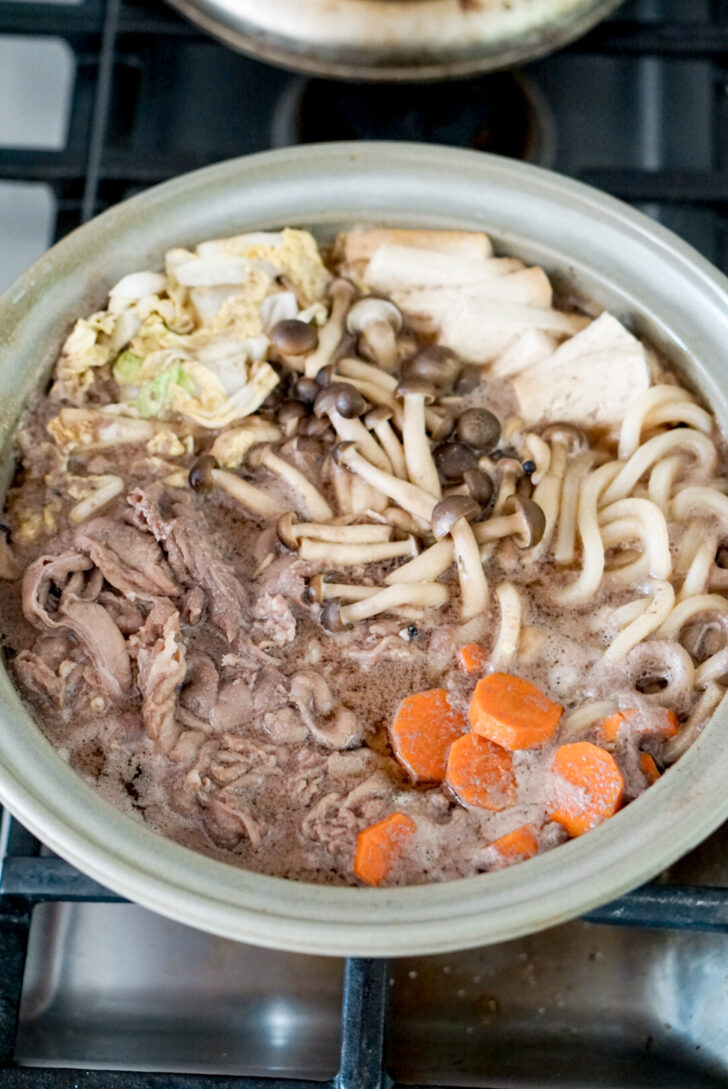
Typically, the main protein in sukiyaki is thinly sliced beef. You can find thin sliced beef at your local Asian market. In Japan, you’ll also commonly find vegetables such as green onions, cabbage, onion, carrot, shiitake or enoki mushrooms, and grilled tofu. Another common ingredient to cook in sukiyaki is shirataki noodles, which are made from the konjac plant.
However, please don’t be feel you need to be bound by any arbitrary culinary rules or tradition. Sukiyaki is great for using up leftovers in your fridge! For me, sometimes that means throwing in seafood, even though traditionally you’re more likely to find seafood in other Japanese hot pot dishes. I also have to adjust the ingredients for what I know my children will eat.
Here are some ideas that you can use to inspire your sukiyaki night:
Proteins for Sukiyaki
- Sliced beef (Most essential)
- Sliced pork
- Sliced tofu
- Shrimp
- Fish balls
- Gyoza
Vegetables for Sukiyaki
- Napa cabbage
- Green cabbage
- Spinach
- Enoki mushrooms
- Shiitake mushrooms
- Shimeji mushrooms
- Aburaage
- Deep fried tofu cubes
- Sliced onions
- Bok choy
- Carrot
- Daikon
- Lotus root
- Green onion
- Chrysanthemum leaves
Noodles for Sukiyaki
- Udon noodles
- Shirataki noodles
- Vermicelli noodles
How to Serve Sukiyaki
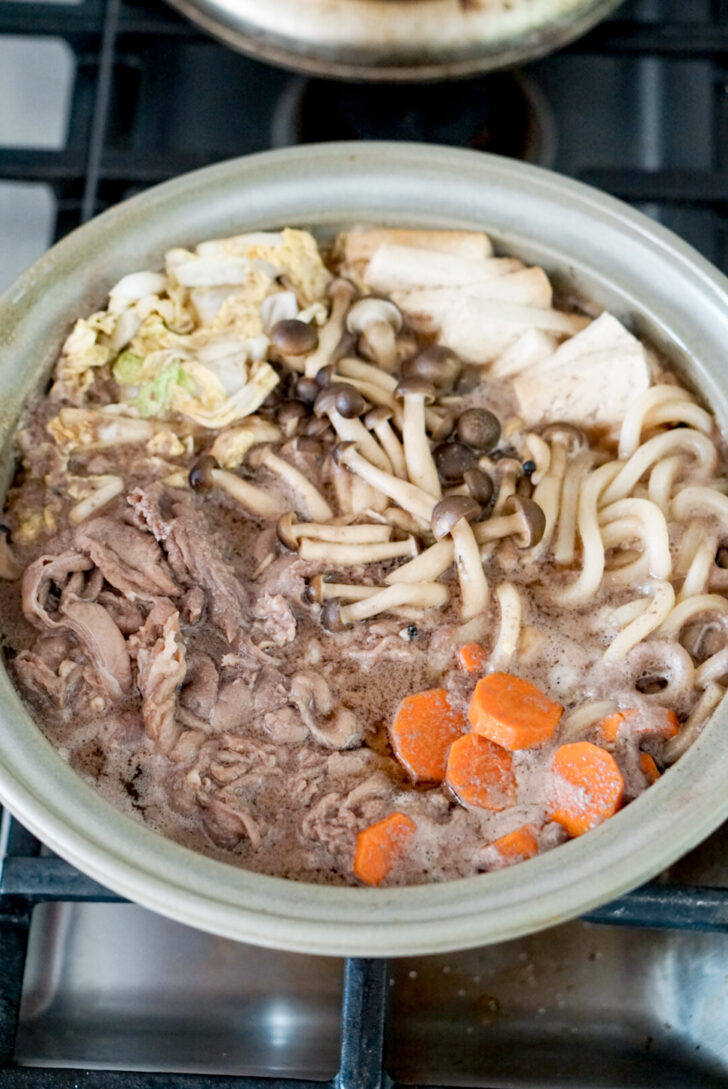
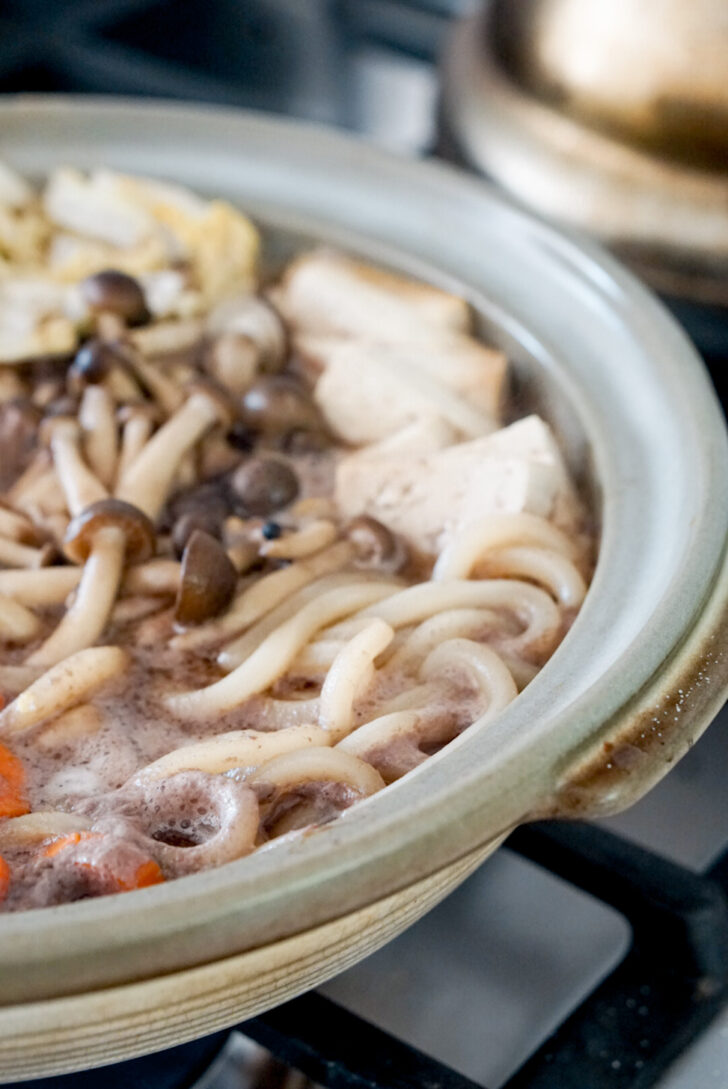
Although typically sukiyaki ingredients would all be boiled in a cast iron pot right on the dining table, don’t feel bound by this rule. I often make my sukiyaki on the stovetop in a 10-12 inch stainless steel skillet with deep sides. I also like to make it in my Japanese clay pot, called donabe, which is what you see in these updated photos. When it’s done, I let my family come choose what they want from the stove and pile it on top of their rice. But if you have an electric hot pot or bunsen burner, it could be fun to cook your sukiyaki in the middle of your dining table, letting your guests pick out food as they eat. I always serve my sukiyaki with rice, but sometimes my husband opts out, eating just the udon noodles for his carbs.
More Japanese Home Cooking Recipes
If you like this recipe, check out my other easy Japanese meals:
Easy Homemade Sukiyaki

Ingredients
For Sukiyaki Broth
- 2 tbsp sugar
- 1/3 cup mirin
- 1/3 cup sake
- 1/3 cup Japanese soy sauce
- 1-2 cups water
- 1 tsp dashi powder
For Sukiyaki Ingredients
- 1 lb thinly sliced beef
- 1/4 head napa cabbage, chopped
- 1/4 onion, sliced
- 1/2 block tofu, cubed
- 2 medium carrots, sliced
- 4-5 medium shiitake mushrooms, sliced
- 1 pack udon
Instructions
- In a 10-12 inch skillet with deep sides, combined sugar, sake, mirin, and soy sauce.
- Bring to boil and simmer for 2-3 minutes to boil off the alcohol.
- Add water and 1 tsp dashi powder. Bring back to a simmer. Taste your broth and dilute with more water as needed according to how salty you like your sukiyaki broth.
- Add in all sukiyaki ingredients in order of cook time from longest to shortest. For example, add in the carrots and let simmer for 5 minutes before adding in cabbage. Then a few minutes later add the onions, mushroom, and tofu.
- Add in udon and finally the beef last, so as not to overcook them.
- Serve immediately over white rice.

Pingback: Easy Nikumaki (Japanese Teriyaki Beef Rolls) - Mochi Mommy
Love it!
Awesome dish – wonderful recipe!
In cooking, attitude is everything!
Love your attitude, Kristen!
Thank you!
Pingback: The Best Teriyaki Chicken (Japanese American Family Recipe)
Pingback: Easy Yakiudon Recipe (Stir Fried Udon) - Mochi Mommy
This was my first time making sukiyaki. I have very picky eaters, but everyone loved it because it’s so versatile! Thank you for giving us creative freedom and a good list of alternative ingredients – that makes it inexplicably less stressful for those of us who think too black and white. It was delicious and easy, and I will definitely be making it again! Thank you!
Hi! Is it ok just to mix everything for the soup broth together and then boil it all in the hotpot together before throwing in ingredients or does it make a big difference to boil first the alcohol off and then add the water/dashi? Thanks!
I highly recommend boiling the alcohol off first! It’s possible to let it boil off after mixing everything together, but it’ll take much longer.
Thanks for this recipe. It is really simple and I love the clean ingredients. I’ve made it twice now and the whole family devours it. I use chicken breast, tofu, veggies and udon noodles. Delicious!
Pingback: The Best Beef Teriyaki (Japanese American Family Recipe)
I made it as a soup instead of a sauce! I definitely had to add more water in order to dilute it but it turned out beautifully! I wanted to ask, is there any subsitute for the sake if I want to make it halal (no alcohol)?
Hi Renee, that sounds great! I’m glad you liked it! I’m not a huge expert on halal food – is burning off the alcohol not enough to make it halal? If that’s the case, I’ve heard that you can use diluted rice vinegar, but I haven’t tried it myself so I can’t say for sure how it would turn out.
I made this today. It’s a great, easy to follow recipe and sooo delicious!
Thank you🙏 and thank you for all the info on this page, it helped me a lot👍😊💖
Thanks so much for leaving a review! I’m glad I could be helpful!
I made this today. It’s a great, easy to follow recipe and sooo delicious!
Thank you🙏