Japanese New Year Food (About Osechi Ryori and Easy Recipes to Try)

Learn about the foods that Japanese people eat on New Year’s Day, both traditional and modern, along with some recipes for you to try at home. Disclaimer: This post contains affiliate links.
New Year’s Day is arguably the biggest and most important holiday in Japan. It’s celebrated on January first, just like a Gregorian calendar New Year. Like Christmas or Thanksgiving in America, New Year’s is the day in Japan that family comes together and eats a big feast!
Are you looking to celebrate New Year’s like in Japan? Well, it’s tough to say exactly what to do, as every region will have some different local specialties and every family will also have some different traditions. Furthermore, many Japanese Americans have strayed away from many of the traditional New Year’s foods and instead have our own Japanese American New Year’s food that is unique to our culture. Here are a few suggestions for where to get started.
What is Osechi Ryori – Japanese Traditional New Year’s Food
Traditional Japanese food for New Year’s is called osechi ryori and New Year’s is called oshougatsu. (You could say you eat osechi ryori for oshougatsu.) Osechi ryori is a set of various traditional foods that often come in a tiered, square laquer box, called jubako. It’s sort of like a very large bento. A jubako is meant to feed an entire family, sometimes even for a few days.
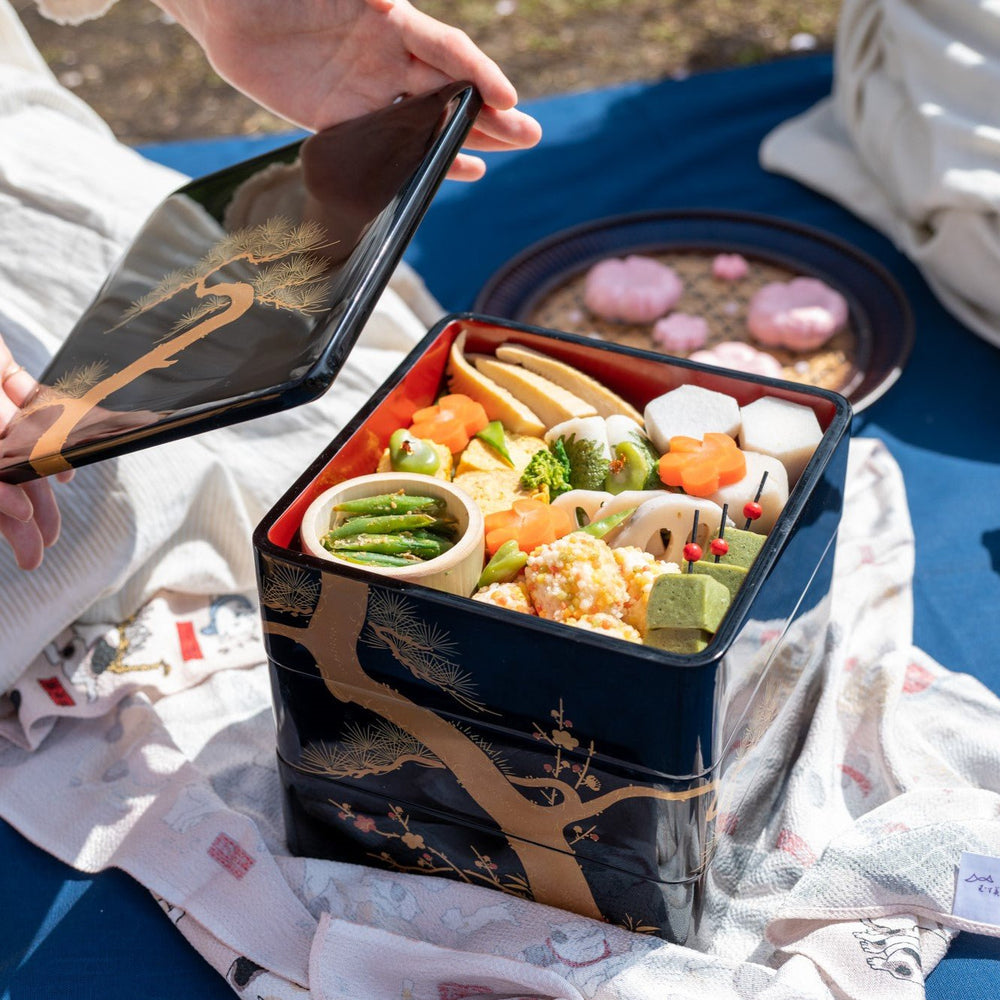
Of course, you can make your osechi ryori from scratch. However, I find among most of my Japanese friends that they order their jubako from local restaurants or grocery stores. Even where I live in Seattle the local Japanese restaurants and grocery stores offer special New Year’s Day osechi sets. If you want to celebrate to be the most like Japan, I recommend finding a local Japanese restaurant to order from if you can.
Some Common Osechi Ryori Foods
- Datemaki tamago (sweet rolled omelette)
- Kuri kinton (mashed Japanese sweet potatoes with candied chestnut)
- Kohaku namasu (a quick pickled salad made from julienned daikon radish and carrots)
- Kuromame (slightly sweet black soybeans)
- Tataki Gobo (pickled burdock root)
- Kazunoko (marinated herring roe)
I do not have recipes for these traditional dishes as I never make them (I actually don’t know anyone who does). For the datemaki tamago and kohaku namasu, I often buy it at my local Japanese grocery store. I do have a recipe for quick pickled vegetables that should work just fine to make a kohaku namasu if you’d like to julienne the daikon and carrots yourself. I never seem to get mine thin enough.
More Japanese New Year Food Traditions
Jubako and osechi ryori are not the only ways to celebrate a Japanese New Year. There are various other food traditions associated with this holiday that you can partake in! In fact, I typically prefer these foods over osechi ryori anyway.
What do Japanese People Eat on New Year’s Eve?
One food tradition that’s super easy to do is New Year’s Eve soba, or toshikoshi soba. Soba are Japanese buckwheat noodles that can be eaten cold or hot. Even though it has a special name, actually toshikoshi soba is the same as regular soba. If you buy soba at a grocery store, it even has directions for you on how to took it on the package. Typically you boil the noodles for five minutes and then put it in a broth. While you can also make the broth from scratch, actually I usually use a Japanese soup broth concentrate called tsuyu. Both soba and tsuyu are very cheap and pretty easy to find (even on Amazon).
You can top toshikoshi soba with whatever you want – green onions, tempura, kamaboko.
I was told to eat toshikoshi soba AT midnight, which I have done before with my friends and family. However, I don’t think it’s necessarily a common practice to eat it at midnight on the dot.
Is There a Japanese New Year’s Dessert?
Desserts are not a huge part of East Asian holidays in general and are not the main focus of a Japanese New Year’s feast, at least not in the same way that pies are to Thanksgiving or cookies are to Christmas. However, there is one sweet food that is somewhat associated with New Year’s in Japan: daifuku mochi. If you have any interest in Japanese food, you probably already know daifuku mochi. It’s name means “big luck” and it consists of a ball of mochi dough stuffed with sweet red bean paste. There are many modern flavor variations, but the most traditional version is with red bean.
Mochi in general is a dish associated with New Year’s but it is often prepared in savory ways (see the next two mochi dishes below). However, you can take fresh mochi and dip it in kinako (roasted soybean powder) and sugar for a sweet version. Ground up black sesame seeds and sugar is another variation that is not uncommon.
Kagami Mochi
In the weeks leading up to oshougatsu, it is common for Japanese families to participate in mochi-making events, called mochitsuki. Or if you’re not going to participate in the actual making of mochi, it is common to buy fresh mochi in preparation for New Year’s.
One New Year’s tradition that uses mochi is kagami mochi. You stack two mochi on top of each other and top it with a Japanese orange. It’s actually used as a decoration, with the mochi drying out and getting hard as it sits on the counter. Then, after the New Year, the mochi is broken with a hammer in a ritual called “kagami biraki.” You can then eat the mochi in soup like ozoni or zenzai… although… to be honest… if your mochi has been sitting up on the counter for weeks I wouldn’t.
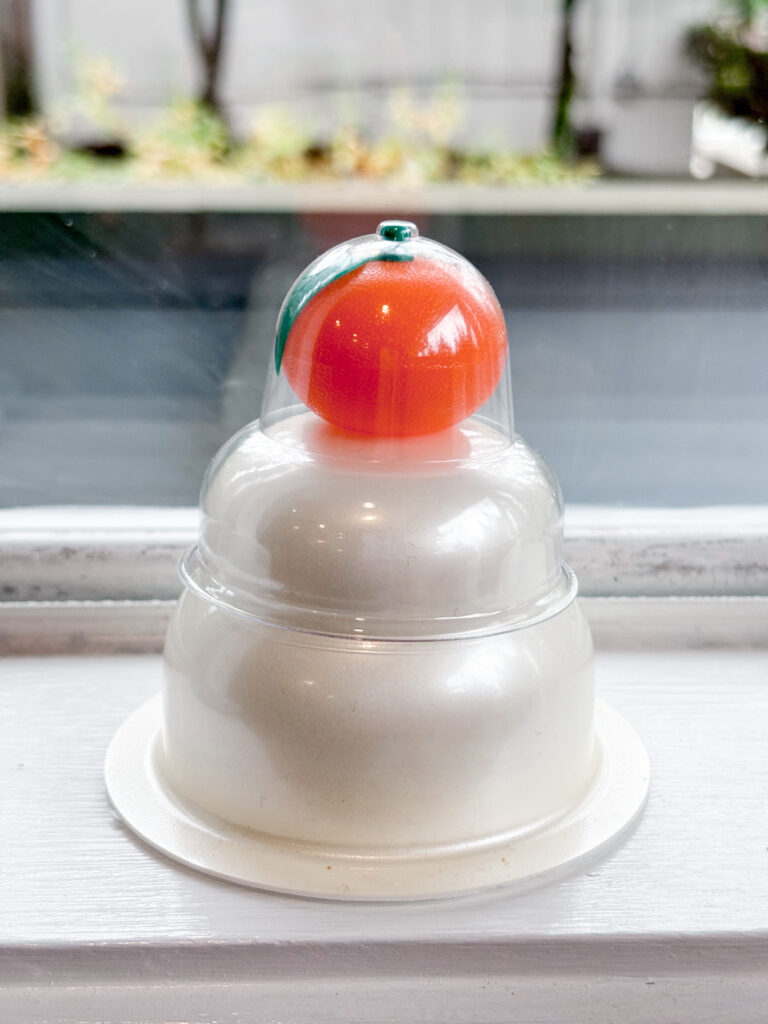
Most people I know get a plastic kagami mochi as decoration. You can find them around New Year’s at Japanese grocery stores or even at Daiso (Japanese dollar store). They sometimes come with plastic wrapped mochi inside, which you can eat.
Ozoni
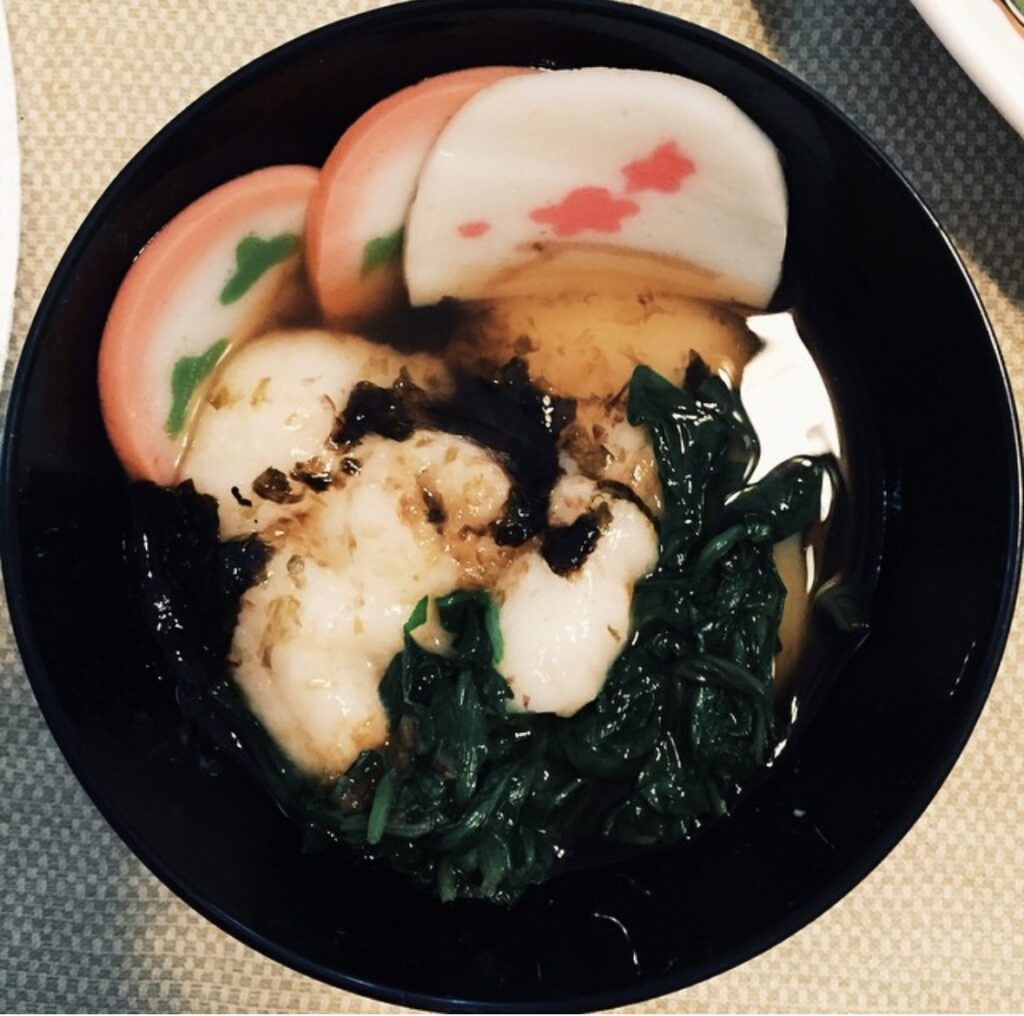
If you’re going to participate in one Japanese New Year tradition, let it be this one: ozoni. Ozoni is a savory mochi soup eaten specifically for New Year’s Day. The broth is typically dashi-based with soy sauce (how much you add often depends on what region of Japan your family is from). It has various toppings, which also vary according to different regions. My grandma always did spinach, kamaboko, and seaweed. I’ve also seen shiitake mushrooms, carrots, and other vegetables in other families’ ozoni. The most important part is mochi – plain, unsweetened pounded rice cake. You can buy this fresh or you can buy it plastic wrapped at the grocery store. Some regions of Japan use boiled mochi while others use toasted mochi, but it simply is not ozoni if you don’t have mochi.
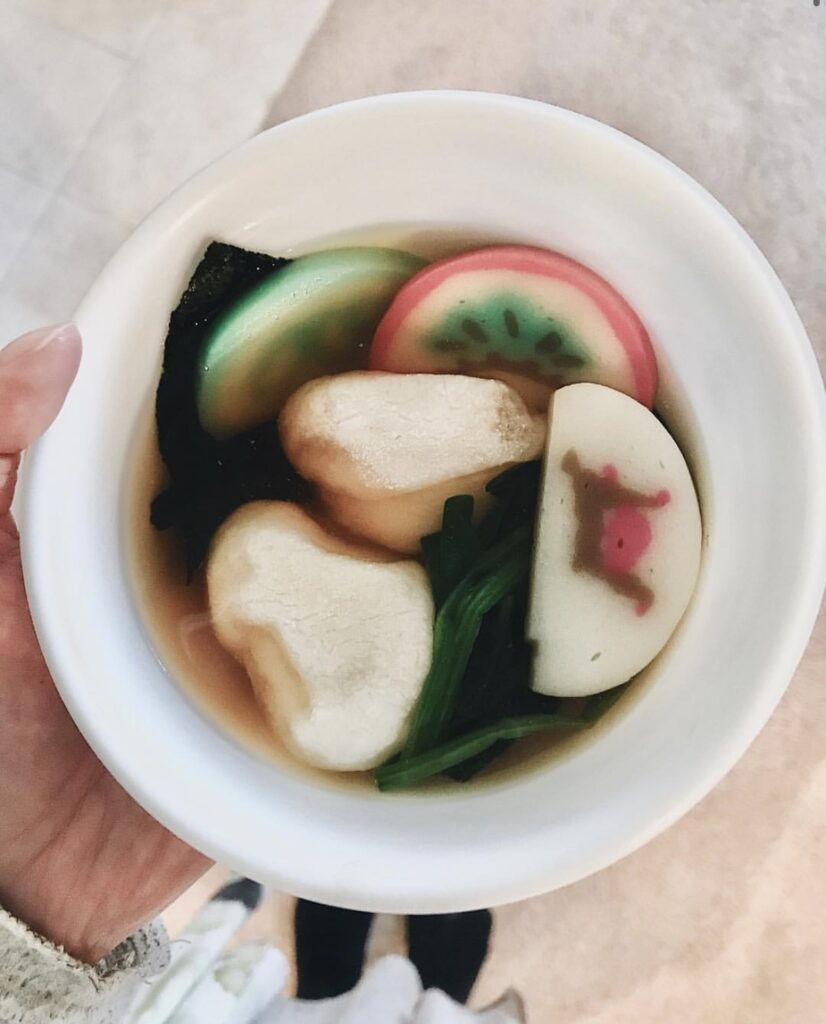
While there are also many differences between how Japanese and Japanese Americans celebrate the New Year, ozoni is something we both have in common. If you’d like to try making ozoni, here’s generally how I make mine:
Start with 4 cups of dashi. You can use an instant dashi powder or dashi pack that you steep. My favorite brand is Kayanoya. It’s very expensive in America! So buy in Japan if you are on vacation there. Next, add one tbsp each of sake and soy sauce. Taste your broth and adjust to however you like. You can add more soy sauce, you can add sugar too if you want a little sweetness.
Then all you have to do is add your toppings. Cook your toppings separately and add to each individual bowl. So on the side, I may have some sliced kamaboko, roasted seaweed, cooked spinach… and of course cooked mochi. If you don’t know what mochi to use, check out my kirimochi page for what to buy at the store.
Japanese American vs. Japanese New Year Foods
My Japanese family has been in America over 100 years now, so as you might imagine, our taste buds have adapted to more American foods. Even some of my friends who immigrated to America within the past five or so years have said they already feel their tastes have changed. Japanese families who have been in America for a long time, especially those who passed through or still live in Hawai’i, have some unique foods to our cultural subset. Many of my third and fourth generation Japanese American families eat some of these foods for New Year’s instead of the traditional osechi ryori.
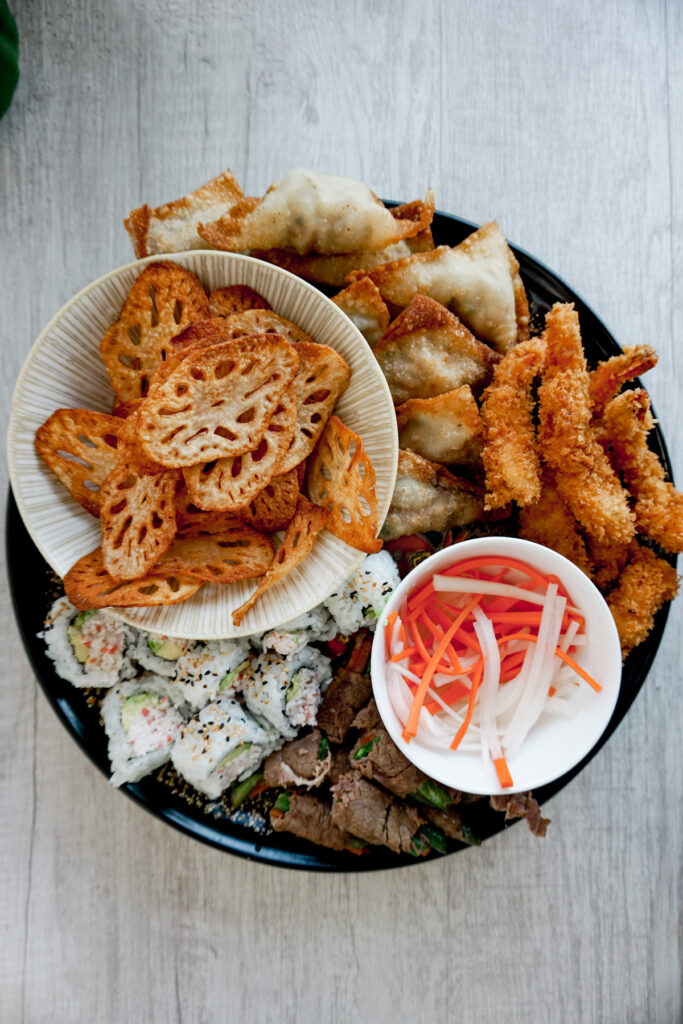
Here are some you can try:
- Deep Fried Lotus Root (Renkon Chips)
- Deep Fried Wontons
- Teriyaki Beef Rolls
- Quick Pickled Veggies (Use on carrots and daikon)
Bonus: How to Wish a Happy New Year in Japanese
If you’re looking to incorporate more Japanese culture into your New Year’s Day celebrations, I hope this helped. Here’s a little bonus for you too – how to wish someone a happy new year in Japanese. Did you know there’s two different ways?
If you’re wishing someone a happy new year BEFORE the New Year has already passed (e.g. in December), then you want to say “yoi o-toshi wo,” aka have a good year. If it is January 1 or later, you want to say “akemashite omedetou” which is a more direct translation for Happy New Year (literally congratulations on opening the year).
So regardless of when you are reading this, I wish you a Happy New Year!